
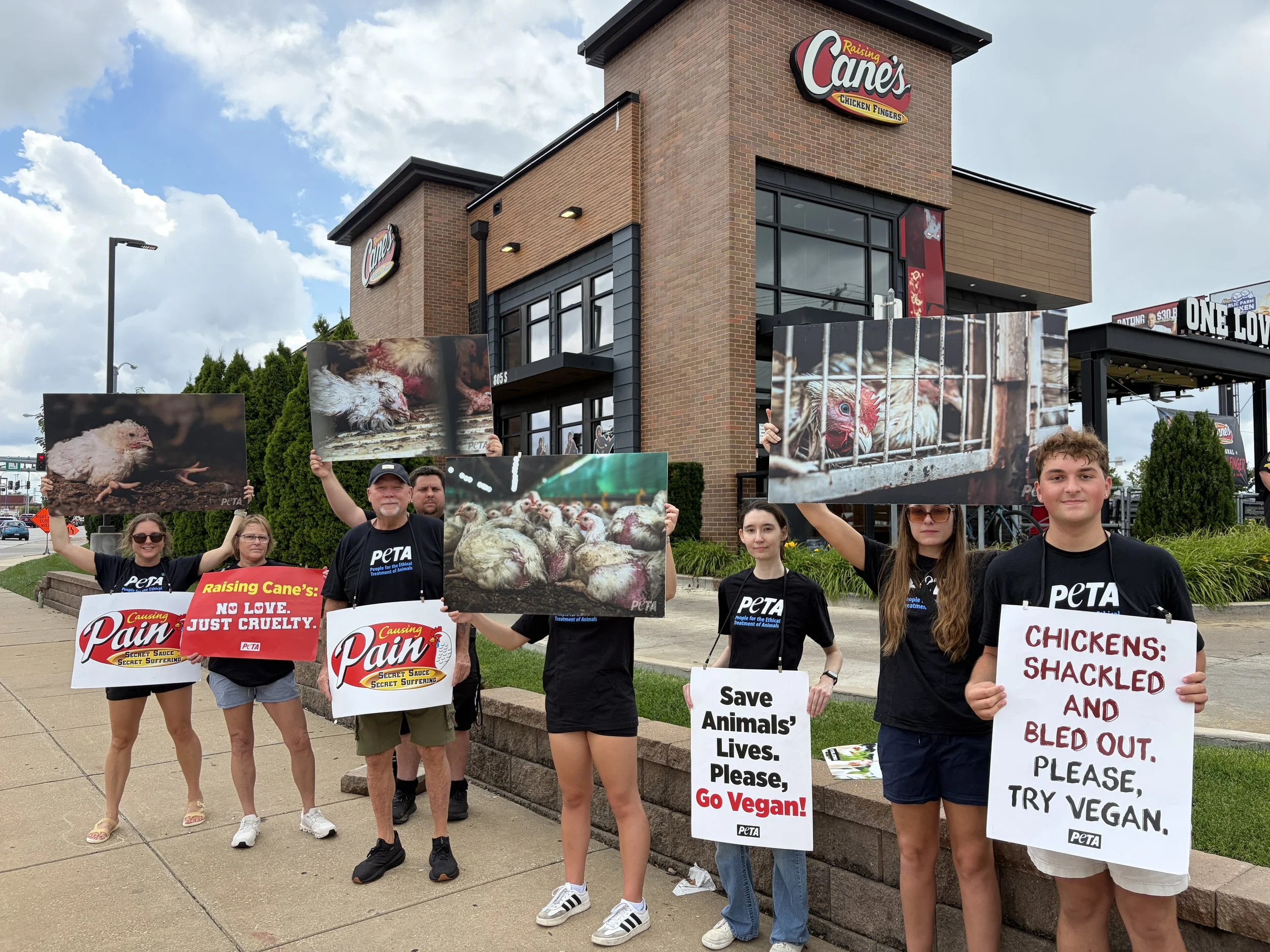
By Kyle Luzynski | Last updated July 2026
The largest animal rights organization in the world is also the most criticized. After years of working alongside them, here is why I think our movement’s reflexive contempt for PETA costs animals their lives.
Dear friends:
I worry there is a tendency to “over-problematize” organizations in the animal rights movement. Take our movement’s largest and most visible organization: PETA.
As much as I would like to issue a universal defense of PETA, I do think that a small (but not entirely insignificant) amount of their campaign messaging may be problematic.
The Critiques of PETA I Take Seriously
In particular, I have witnessed several takedowns by feminist, anti-ableist, and other key figures in the consistent anti-oppression movement concerning PETA, and I feel logically and morally compelled to agree with many of their critiques, analyses, and conclusions.
One recurring critique, for example, is that PETA has often depicted people—especially women—in sexualized and potentially exploitative ways in order to make a point about animals. I find much of that critique persuasive.
A related concern, and one I feel more personally, is which bodies get chosen in the first place. PETA’s campaigns have tended to favor conventionally attractive people over everyone else. But vegans come in all shapes and sizes, and as a fat vegan, I would like to see larger people better reflected in future campaigns.
Naturally, these are just two of many critiques, and I want to say plainly that critiquing PETA and other leading animal advocacy organizations is not only necessary, but incredibly valuable to the overall success of our movement. It would also be a profound disservice to other social justice advocates and their work to summarily dismiss their critiques, especially without carefully and methodically weighing them first.
Why “Over-Problematizing” PETA Hurts the Animal Rights Movement
That said, I have noticed a trend among more casual observers to uncritically and reflexively hate PETA and the invaluable work they perform, not because PETA is truly that problematic (at least in my personal estimation), but because it is easy to dislike industry leaders in virtually any field.
This hate, contempt, and distrust of PETA ironically echoes the kneejerk reactions of many speciesists when the organization comes up in private conversation and public discourse alike.
Granted, I don’t believe the people expressing such concerns are acting in bad faith, but I do wonder: is “over-problematizing” PETA actually harmful to the movement? Even after accounting for the foregoing concerns, I would argue that yes, it is. Here's why.
Ten Reasons I Support PETA
First: The Raw Utility of What PETA Accomplishes for Animals
We need to consider the raw utility of what PETA accomplishes for the animals. They are, far and away, the largest animal rights organization in the world, and the sheer number of campaigns they run could fill an entire book.
Second: Nearly Half a Century of Victories for Animals
PETA has arguably done more to advance the cause for animal liberation than any other organization in history, racking up literally thousands of victories for the animals, many of which would not have happened (or happened nearly as soon) without their tireless advocacy and critical support, which now spans nearly half a century.
Third: In All My Work With PETA, I Have Never Felt Used
The accusation that PETA maliciously targets and exploits smaller organizations, groups, and activist networks does not match my experience. Across all my work with PETA, I have never once felt used; instead, I have felt supported, appreciated, and genuinely cared for, with several PETA team members, in particular, going above and beyond to help us.
Fourth: Our Movement Is Big Enough for Strategic Disagreement
I am aware of several strategic disagreements in the movement, including those surrounding PETA’s decision to prioritize the fight against leather, down, and other animal products used for clothing over more traditional anti-fur advocacy.
While I understand these frustrations, especially with the shift away from Fur Free Friday, I believe our movement is big enough to accommodate not only strategic disagreements, but a wide diversity of robust (and potentially conflicting) theories of change.
Indeed, perhaps the most consistent finding of social movement and vegan advocacy research organizations (like Faunalytics) is that a broad spectrum of strategies, tactics, and theories of change are needed to not only maximize the overall impact of our movement, but achieve animal liberation as quickly, effectively, and strategically as possible. No one theory of change is sufficient to control, dictate, or lead the animal rights movement to victory (though some, I believe, are certainly stronger and more grounded than others).
Fifth: My Own Core Disagreement — and What I Do With It
I have my own core disagreement with PETA’s strategy that I don't believe I have seen anyone else tender. This has to do with the critical yet neglected importance of embracing a chapter model for vegan outreach and maximum impact. But instead of attacking PETA, I transmute that energy into building Project Animal Freedom (PAF).
Sixth: No One Does More for Grassroots Groups
PETA likely does more than any other organization in the world to support smaller animal rights groups, organizations, and networks. I understand there may be some opportunism in claiming credit for various victories, but in my experience, PETA properly credits the local activists, the organizations they represent, and the impacts they help drive.
Seventh: Real Harms, Weighed Against Enormous Goods
Sometimes the goods are so great that the attending harms, real as they are, cannot reasonably outweigh them—especially if your goal is efficacy, not perfection. If you drive billions of impressions for animals annually, deliver (or help deliver) thousands of campaign victories, and invest literally millions of dollars in time, energy, effort, supplies, training, media outreach, event promotion, campaign logistics, coordination, movement-building, funding, reimbursement, and other services, resources, and material support to assist smaller grassroots groups, organizations, and activists, perhaps you aren’t the exploitative, opportunistic “movement monster” some people claim you are.
Eighth: PETA Is Not McDonald’s
People seem to have a natural tendency to dislike, critique, and outright attack the leading business (or organization) in any sector. But PETA is not McDonald’s. It is not Facebook. It is not Amazon. And it does not deserve the shocking level of ire some activists direct at it.
Ninth: What PETA Has Done for Our Grassroots Organization
PETA has done more to support the small, grassroots organization I founded than any other organization in the movement. This is not to discount the significant, deeply meaningful contributions of all our valued business partners and cherished movement allies, but to recognize the unusually generous support PETA has shown us. They have literally saved us thousands of dollars while helping us realize our mission more effectively than ever before.
Tenth: There Is a Difference Between Critique and Discouragement
We should be wary of the moment critique hardens into discouragement. It is one thing to not personally support a fellow animal advocacy organization. It is another matter to critique them, privately or publicly. But it is another matter altogether to treat association with them as disqualifying—to make collaboration something another advocate must justify, apologize for, or quietly decline. Granted, I understand the impulse. But when we go that far, is PETA really the one who pays, or is it the animals we fail to help?
Progress or Perfection: The Trade-Off Our Movement Must Make
PETA has my support not only because of their legacy and scale, but because of the overwhelming heft and impact of their advocacy efforts. I am a proud PETA supporter, not only because of the incredible support they have shown me, my team members, and PAF, but because they genuinely deserve our support, whatever imperfections may yet still exist within their organization and across a small (but not entirely negligible) portion of their advocacy.
So yes, let’s be careful to not “over-problematize” the leading organization in our movement. And if you feel you have irreconcilable differences with them, feel free to not personally support or associate with them, but please refrain from actively discouraging others from being involved in their phenomenal animal advocacy work. Our movement, known for its legendary infighting, already has enough toxic, counterproductive energy to last 10,000 lifetimes.
Yet we don’t even have one human lifetime, let alone several, to spare. Instead, we have at most a handful of years to stop animal agriculture, prevent catastrophic climate change, and secure a livable future for all life on Earth. Are our critiques, however earnest, reasoned, and well justified we believe them to be, really worth delaying impact any further, especially when the risk is not only environmental catastrophe, but our own self-destruction?
We must be rigorously strategic, and we must support the best vehicles presently available for achieving animal liberation, even when those vehicles are imperfect. Not because our values are negotiable, but because no flawless organization is coming to save the animals in time. Progress or perfection: that is the trade-off I am convinced we must make, especially given the 5-alarm fire currently engulfing our planet.
With respect to PETA, however, I feel we sacrifice next to nothing and gain almost everything. Whether we should support and uplift PETA or denigrate and lambaste them is therefore obvious to me, especially given the broader context of the compounding crises humanity and the rest of animalkind now face. We are living through a dire emergency of unprecedented proportions, and we must act like it—or perish. There is no middle ground.
Impact or Perfection. Collaboration or Infighting. The Choice Is Yours.
With a movement juggernaut like PETA, therefore, the question is not whether they are perfect. The question is whether they are effective at realizing the aims of our movement. And if our primary concern is changing the world and saving animals, the question is not whether our activism is ideologically pure and morally flawless, but whether it is strategically sound and practically effective.
And there has arguably never been an animal rights organization as effective as PETA, and there may very well never be another organization quite like it ever again. We can join the effort and create change, or we can complain on the sidelines and fail to realize the level of progress possible in partnership with movement players like the ever notorious yet stunningly impactful PETA.
Impact or perfection. Collaboration or infighting. Efficacy or self-destruction. The choice is yours. What will you choose?
Frequently Asked Questions
Is PETA the largest animal rights organization in the world?
Yes. PETA describes itself as the largest animal liberation organization in the world, with PETA entities counting more than 10.4 million members and supporters globally. It was founded in 1980 by Ingrid Newkirk and a small group of friends, which puts its advocacy at nearly half a century and counting.
What are the most common criticisms of PETA?
Within the movement, the critiques I find most worth engaging with come from feminist, anti-ableist, and consistent anti-oppression advocates, particularly around the sexualized depiction of women in campaigns and the narrow range of bodies those campaigns feature. There are also strategic disagreements, PETA’s pivot from fur toward leather, down, and wool being a recent example, and one I don’t necessarily agree with myself. I take the first category seriously, as I’ve written above, and I think the second is a sign of a diverse movement, not necessarily a broken one.
Does supporting PETA mean endorsing everything they do?
No, and this piece is not an endorsement of every campaign PETA has ever run. My argument is narrower: that the gap between PETA’s imperfections and PETA’s impact is enormous, and that treating the former as a reason to discourage others from the latter costs animals more than it protects anyone.
Put this to work in St. Louis. If any of this resonates, the next step is local: find a vegan group near you, join us at an upcoming event, or volunteer with Project Animal Freedom. Their freedom is our freedom. Now let’s fight for it!