

Animal Rights in St. Louis: The Complete Guide to the Movement

By Kyle Luzynski, Executive Director of Project Animal Freedom · Last updated July 2026 · ~20-minute read
The figures in this guide are sourced to primary research and public records from institutions like the London School of Economics, Humane World for Animals (formerly the Humane Society of the United States), Our World in Data, the Sentience Institute, and Missouri state and federal reporting. You’ll find the full list of sources at the end.
The animal rights movement is growing in St. Louis — and whether you’re brand new, already vegan, looking for volunteer opportunities, or simply wondering what “animal rights” actually means, this guide is for you.
Animal rights begins with a simple truth: animals are not things. They are living, feeling individuals with their own experiences, relationships, fears, preferences, and desire to live — and they deserve to be safe, happy, and free.
At VeganSTL, powered by Project Animal Freedom, we are building the movement for animal freedom in St. Louis and across the Midwest. Our mission is bold but clear: a fully vegan Midwest by 2056, built through community, strategy, outreach, events, and local chapter-building.
This guide explains what animal rights means, how it differs from animal welfare, why Missouri sits closer to the center of this fight than almost any state in the country, how the St. Louis movement got here, honest answers to the most common objections — and, most importantly, how you can take action for animals right here in the Gateway City. It’s written from the ground: we organize the marches, run St. Louis’ only 100% vegan monthly market, maintain the region’s most comprehensive vegan guide, and train the volunteers building this movement one event at a time.
St. Louis is where that future starts.
Animal Rights in St. Louis at a Glance
| If you want to… | Start here |
|---|---|
| Understand what animal rights means | Keep reading — start with “What Is Animal Rights?” below |
| Eat in a way that matches your values | The STL Vegan Guide and our complete guide to veganism |
| Meet the community | VeganSTL events, STL Vegan Market, and local groups |
| March for animals | The March to Close All Slaughterhouses — Saturday, September 5, 2026 (details) |
| Take action regularly | Volunteer with Project Animal Freedom |
| Report animal cruelty or neglect | The Humane Society of Missouri’s Animal Cruelty Task Force, on call 24/7 (see FAQ below) |
| Fund the movement | Donate to Project Animal Freedom |
In This Guide
What Is Animal Rights?
Animal rights is the belief that animals matter for their own sake.
Animals are not products. They are not machines. They are not ingredients, costumes, test subjects, entertainment props, or tools for human convenience. They are individuals with subjective experiences — capable of pain, fear, stress, comfort, curiosity, pleasure, social connection, and, in many cases, grief.
Animal rights asks us to expand values we already believe in — compassion, fairness, freedom, and justice — beyond the human species.
The argument is not that animals are identical to humans. They are not. A pig does not need the right to vote, and a fish does not need a driver’s license. The point is much more basic:
If an animal can suffer, their suffering matters.
If an animal wants to live, their life matters.
If an animal has interests of their own, those interests should not be dismissed simply because someone can profit from ignoring them.
At its core, animal rights means animals should not be bred, owned, confined, exploited, or killed for human purposes when better alternatives exist — whether they are used for food, clothing, entertainment, experimentation, or breeding.
At its heart, animal rights means this:
Animals are someone, not something.
The Science Is on the Animals’ Side
This isn’t sentiment. It’s the direction the evidence has been moving for decades. Research credits chickens with numerical reasoning, self-control, and social cognition once assumed unique to primates, and pigs are widely regarded as among the most cognitively sophisticated farmed animals on earth. In 2021, a landmark review commissioned by the UK government and led by the London School of Economics weighed more than 300 studies and concluded that octopuses, crabs, and lobsters are sentient — capable of feeling pain and distress — and Britain now recognizes them as sentient beings in law, alongside all vertebrates. And the 2024 New York Declaration on Animal Consciousness, signed by roughly forty scientists, holds that there is strong scientific support for conscious experience in mammals and birds, and at least a realistic possibility of consciousness in all vertebrates — fish included — and in many invertebrates.
Most people already believe cruelty to a dog or cat is wrong — abusing or neglecting an animal is a crime in Missouri. Animal rights is what happens when we extend that same basic concern to the cows, pigs, chickens, and fish whose suffering is usually hidden from view. According to UN Food and Agriculture Organization data compiled by Our World in Data, more than 80 billion land animals are raised and killed for food worldwide every year — around 10 billion of them in the United States — and researchers estimate that 1.1 to 2.2 trillion wild fish are pulled from the water annually on top of that. The Sentience Institute estimates that roughly 99% of farmed animals in the United States live on factory farms. Behind every one of those numbers is an individual.
The Animals at the Center of the Movement

Animal rights is not abstract. It is about real animals.
It is about the cow whose calf is taken away so humans can drink the milk meant for her baby.
It is about the hen bred to lay far more eggs than her body was built to handle.
It is about the pig — intelligent, social, playful — confined in an industrial system that treats her as a unit of production.
It is about the chicken bred to grow so unnaturally fast that her own body becomes a burden.
It is about the fish pulled from the water in systems that rarely count their suffering at all.
It is about the mouse in the laboratory, the fox killed for fur, the elephant confined for entertainment — and the countless animals whose suffering stays hidden because powerful industries depend on the public not looking too closely.
Animal rights begins when we look directly at those animals and say:
You are not a thing.
Your pain matters.
Your life belongs to you.
Animal Rights vs. Animal Welfare: What’s the Difference?
Animal welfare asks, “How can we treat animals better while still using them?”
Animal rights asks, “Should we be using them at all?”
Both approaches oppose obvious cruelty. Both care about suffering. But they disagree about the deeper moral question: whether humans are entitled to use animals in the first place.
| Animal welfare | Animal rights |
|---|---|
| Reduces suffering within industries that use animals | Challenges the use of animals as products in the first place |
| Supports larger cages, better handling, “humane” slaughter | Holds that cages, forced breeding, and slaughter are wrong even when made less cruel |
| Accepts animals as human property | Rejects treating sentient beings as property |
| Asks: are animals treated “humanely”? | Asks: are humans justified in using animals at all? |
| Example: cage-free eggs | Example: egg-free eating and vegan alternatives |
| Example: better slaughterhouse rules | Example: a world without slaughterhouses |
Welfare reforms can reduce some suffering, and reducing suffering is better than maximizing it. Shelters, rescues, and cruelty investigators save individual animals every single day, and St. Louis is fortunate to have strong ones. But a bigger cage is not freedom. A “humane” slaughterhouse is still a place where animals are killed against their will. A label on a carton does not change the fact that an animal’s body was treated as a product.
That is why Project Animal Freedom takes an animal rights position. We are not working for slightly better factory farms — we are working for a world without factory farms. We are not trying to make slaughterhouses more palatable — we are working for a future beyond slaughterhouses entirely.
Why Veganism Is Central to Animal Rights
Veganism is animal rights in action.
Animal rights is the principle: animals should not be exploited. Veganism is the practice: withdrawing our support — as far as is possible and practicable — from the industries that exploit them. That starts with meat, dairy, eggs, and fish, and extends to leather, fur, wool, down, cosmetics tested on animals, and entertainment that uses animals as props.
For most people, the biggest impact begins with food, because food is where the largest number of animals are exploited and killed. Every vegan meal is a withdrawal of support from industries that breed, confine, and kill animals for profit — and a signal to every restaurant, grocery store, and family table in St. Louis that animals matter and better options exist.
Veganism is not about purity or perfection. It is about doing what we reasonably can. And at VeganSTL, we don’t present veganism as deprivation. We present it as an invitation:
An invitation to eat incredible food.
An invitation to live more consistently with your values.
An invitation to join a growing community.
An invitation to build a kinder St. Louis.
New to all of this? Start with our complete guide: What Is Veganism?
Bigger Than One Issue: Animals, Workers, and the Planet

Animal rights begins with animals, but it does not end there. Factory farms and slaughterhouses shape land use, water, climate, worker safety, public health, and rural communities. A 2023 Oxford study in Nature Food that linked the diets of more than 55,000 people to data from 38,000 farms in 119 countries found vegan diets produce roughly a quarter of the greenhouse gas emissions of high-meat diets and use about 75% less land — with similar advantages on water pollution and biodiversity.
Factory farms hurt animals.
They exploit workers.
They pollute waterways and warm the climate.
And they teach a society to normalize domination of the vulnerable.
That doesn’t mean veganism solves everything by itself. It means animal rights belongs inside the broader fight for a more compassionate, sustainable, and just world — what we sometimes call the Swiss Army knife of social justice. For the full evidence on health and the environment, see our veganism guide.
Why Animal Rights Matters in Missouri
If you live in St. Louis, you don’t live on the sidelines of this issue. Missouri sits near the center of animal exploitation in America — which gives our region a special responsibility, and a special opportunity.
Missouri is the puppy mill capital of the United States. For the 14th consecutive year, Missouri topped the “Horrible Hundred” report from Humane World for Animals (formerly the Humane Society of the United States), which documents the country’s problem puppy mills. The 2026 report cited 31 Missouri commercial dog breeders — more than twice as many as any other state — for violations including filthy and unsafe conditions, underweight dogs, untreated illness, and animals left without adequate food, water, or shelter in extreme weather.
Missouri is an animal agriculture powerhouse. By USDA counts, Missouri ranks third in the nation for beef cows, fifth for turkeys, and seventh for hogs. Millions of animals are raised, confined, transported, and killed in Missouri’s animal-agriculture system every year. The scale can numb us — which is exactly why animal rights insists on seeing individuals, not statistics.
Missouri’s laws have often protected industries, not animals. In 2018, Missouri became the first state in the nation to restrict plant-based foods from being labeled as “meat” — legislation drafted with the state’s cattle industry and immediately challenged in federal court on free-speech grounds by Tofurky, the Good Food Institute, the ACLU of Missouri, and the Animal Legal Defense Fund. And when Missouri voters passed Proposition B, the Puppy Mill Cruelty Prevention Act, in 2010, the legislature rewrote it within months — stripping out core protections like the cap on breeding dogs before the law ever fully took effect.
None of this is cause for despair. It is cause for organizing. The animal rights movement cannot succeed only in Los Angeles, New York, or Portland — if animals are going to be free, the movement has to win in the Midwest, in cities with deep community roots, practical people, and real cultural weight. The Midwest is bound up with industrial animal agriculture, which means a strong movement here matters more than almost anywhere else. When St. Louis moves, the Midwest notices.
A Brief History of Animal Rights in St. Louis
The modern animal rights movement took shape in the 1970s and 1980s, as philosophers like Peter Singer (Animal Liberation, 1975) and Tom Regan (The Case for Animal Rights, 1983) gave language to a simple conviction: animals’ interests deserve genuine moral weight.
St. Louis joined that story early. The St. Louis Animal Rights Team (START) formed in 1985 and has spent four decades leafleting, demonstrating, tabling, and educating on behalf of animals — proof that this city has long had people willing to speak up for those who cannot speak for themselves.
In recent years, the movement has grown new roots. Project Animal Freedom was founded in St. Louis in 2018 with an explicitly strategic mission: a fully vegan Midwest by 2056, built through local chapters, recurring events, and durable community infrastructure. In 2023, local entrepreneur Melissa Crawford founded STL Vegan Market; Project Animal Freedom has run it since 2024, growing it into the most attended vegan event in St. Louis, with more than 5,700 attendees across the 2025 season. Today, thousands of St. Louisans take part in vegan and animal rights events every year, and the movement’s public presence — markets, marches, campaigns, media — is stronger than it has ever been.
VeganSTL and Project Animal Freedom are proud to carry this work forward in our own way: by building a visible, welcoming, strategic vegan movement rooted in local community.
The St. Louis Animal Rights Movement Today
A strong local guide should be honest: VeganSTL and Project Animal Freedom are not the only people working for animals in this region — and a movement is bigger than any one organization. Here’s the landscape, and where each piece fits.
Project Animal Freedom and VeganSTL. We are the strategic movement-building hub: public events, STL Vegan Market, the STL Vegan Guide, Veganuary, marches and demonstrations, volunteer programs and activism trainings, and chapter-building across the Midwest. Our focus is making veganism and animal advocacy visible, social, organized, and mainstream.
St. Louis Animal Rights Team (START). The city’s longest-running animal rights group, active since 1985, with a long record of demonstrations, educational booths, and community outreach. START also sponsors St. Louis VegFest, the region’s annual vegan festival of food, vendors, speakers, and nonprofits — returning October 11, 2026, in Forest Park. Different organizations, one movement — animals need all of us.
Vegan community groups. St. Louis has a growing network of vegan community spaces — from St. Louis Vegans to LGBTQIA+ Vegans of St. Louis and more — because social support is one of the most underrated parts of advocacy. Explore local groups →
Animal welfare and rescue organizations. St. Louis also has a strong animal welfare ecosystem doing a different, complementary job: rescuing individual animals in crisis. The Humane Society of Missouri’s Animal Cruelty Task Force receives more than 20,000 reports of suspected abuse and neglect each year and is on call 24/7 in St. Louis City and County, and area shelters and rescues care for thousands of homeless dogs and cats. These groups do welfare work rather than rights advocacy — and if you ever see an animal in danger, they are who to call (see the FAQ below for exactly how). The animal rights movement should honor that care work while inviting people to widen the circle.
Whatever door you walk through, what matters is walking through it.
How Project Animal Freedom Advances Animal Rights
We advance animal rights by making veganism visible, social, practical, and normal. We are not only asking people to care about animals. We are building the community infrastructure that helps people act on that care.
Our work includes:
STL Vegan Market and other major vegan community events
The STL Vegan Guide and local vegan resources
Veganuary and beginner-friendly vegan challenges — 768 St. Louisans took the challenge in January 2026
The Fish Free Fry — our 100%-vegan Lenten twist on a beloved St. Louis tradition
Marches, demonstrations, and public outreach campaigns — including collaborations with national organizations like PETA
Volunteer meetings and activism trainings
Vegan education and digital campaigns reaching hundreds of thousands of St. Louisans
Partnerships with vegan businesses and community leaders
Chapter-building across the Midwest — because St. Louis is just the beginning
Every event, guide, meal, conversation, post, and volunteer shift helps move St. Louis closer to animal liberation.
Our Theory of Change: Compassion Plus Strategy
Compassion is powerful. But compassion needs structure.
Project Animal Freedom exists to turn compassion into a movement.
We do that by building systems: local chapters, recurring events, volunteer teams, digital outreach, community spaces, leadership pipelines, and campaigns that make veganism more visible and accessible.
We want animal rights to become more than a belief held by a small group of people. We want animal rights to become part of the culture of St. Louis.
A city where vegan food is easy to find.
A city where animal advocacy is easy to join.
A city where compassionate businesses thrive.
A city where more people see animals as individuals.
A city helping lead the Midwest toward a fully vegan future.
The most durable way to get there is not to demand that people change. It is to make the compassionate choice the easy choice — the visible choice, the social choice, the culturally normal choice.
When a St. Louisan walks into STL Vegan Market and eats the best tacos of their life, that is animal rights advocacy. When someone makes three new friends over a plant-based dinner at a VeganSTL social, that is animal rights advocacy. When a restaurant adds a vegan option because customers keep asking, that is animal rights advocacy.
Animal Rights in Action: Marches, Markets, and Campaigns
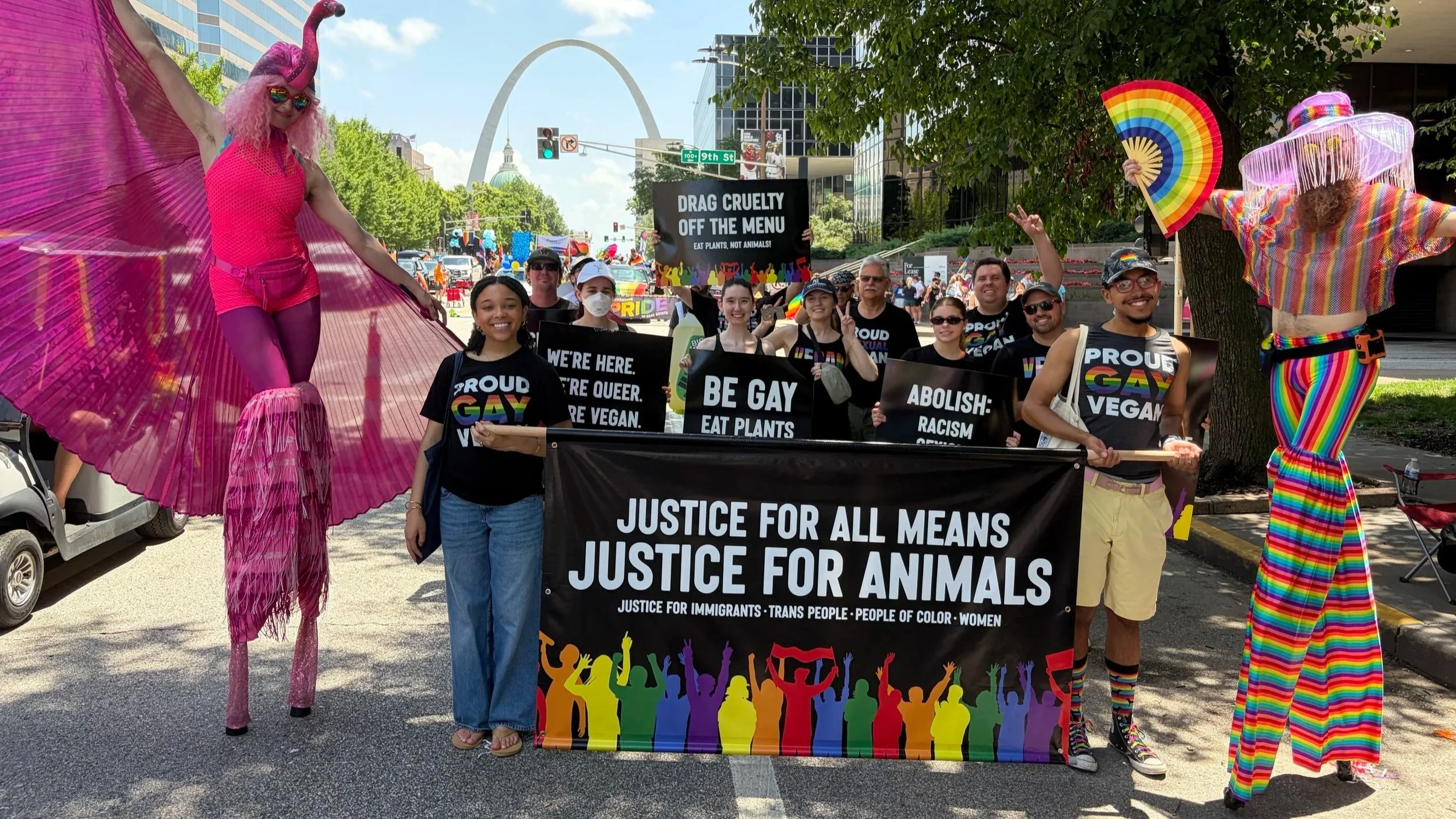
The March to Close All Slaughterhouses — Saturday, September 5, 2026. St. Louis takes to the streets as part of a worldwide movement calling for the abolition of slaughterhouses. The march names the full cost of the system — animals suffer, workers are exploited, communities are polluted — and calls for a slaughter-free world. Route details and updates are on the event page.
STL Vegan Market. On the second Sunday of every month, April through October, STL Vegan Market fills 2 Acre Park in the Central West End with vegan food, cruelty-free makers, and community. For many St. Louisans it’s their first real experience of vegan culture — they come for tacos, pastries, and ice cream, and leave having seen that veganism is delicious, social, creative, and already alive in their city. The market regularly draws 500+ people per event — more than 5,700 attendees across the 2025 season — and reached roughly 730,000 St. Louisans through social media, press, and word of mouth. Our long-term vision is to grow it into a weekly fixture: the Tower Grove Farmers Market of compassionate living. Not everyone goes vegan after one event. But every positive experience makes the next step easier. Advocacy doesn’t always look like a protest. Sometimes it looks like a festival.
Veganuary in St. Louis. Every January, our local Veganuary campaign helps hundreds of St. Louisans try vegan living for a month, with guides, local recommendations, and community events all month long. Because movements are built through relationships: a lonely vegan may burn out, but a connected vegan becomes part of a movement.
The Fish Free Fry: a vegan tradition in a Catholic city. St. Louis loves its Lenten fish fries — so we built a compassionate alternative. Our 100%-vegan Fish Free Fry, catered by Adina’s Vegan Cuisine, whose chef brings more than 30 years of plant-based cooking experience, drew more than 80 guests last year — many arriving as skeptics and leaving as converts. Meeting a beloved local tradition where it lives, and making it kinder: that is what movement-building looks like here.
Protests, outreach, and Pride. Year-round, our volunteers leaflet, table at festivals, run outreach campaigns, and show up where St. Louis gathers — including Pride, because a kinder world has to include everyone, human and nonhuman alike. Protests make invisible suffering visible. Outreach hands people information they might never otherwise encounter. Education connects the love people already feel for animals to the choices they make every day. A healthy movement needs both joy and urgency — welcoming spaces for beginners and bold public pressure on the systems of exploitation. Planning your own action? See our guide to hosting a vegan Pride contingent.
Animal Rights Is Local
Animal rights is not only about what happens far away. It is also about what we build here.
It is in every vegan meal served in St. Louis.
It is in every person who tries plant-based food for the first time.
It is in every volunteer who tables, writes, photographs, organizes, or shares an event.
It is in every restaurant, market, class, campaign, and conversation that makes compassion more visible.
When we build the vegan community in St. Louis, we are building power for animals.
How to Become an Animal Rights Activist in St. Louis: 8 Steps

You do not need a philosophy degree, a perfect diet, or years of experience to become an animal rights activist. You need a willingness to care, learn, and act. You do not have to be perfect to make a difference. You just have to begin.
Start with veganism. The most powerful first step is to stop financially supporting the industries that exploit animals. Start with food: explore the STL Vegan Guide, try Veganuary, swap dairy milk for oat or soy, and lean on our complete veganism guide for everything else. Do not wait until you know everything. Begin where you are. Small changes compound.
Learn the basics. Read about factory farming, animal sentience, and the difference between welfare and rights — the book and documentary lists at the end of this guide are a strong starting point. Then come to a VeganSTL class or volunteer orientation for a local entry point.
Join the community. Movements are built through relationships. Come to STL Vegan Market, a social, or a restaurant meetup — see what’s coming up — and join local groups. Animal rights can be emotionally heavy. Community makes it sustainable.
Volunteer with Project Animal Freedom. Tabling, photography, writing, social media, graphic design, event logistics, research, restaurant outreach, fundraising, beginner support — there is no single way to be useful, and our volunteer meetings and activism trainings will help you grow as an advocate. The movement needs many skills.
Show up in public. Stand with us at the March to Close All Slaughterhouses on Saturday, September 5, 2026, and at demonstrations and outreach events year-round. Marches make the invisible visible — and show every onlooker that this movement is real, local, and growing.
Speak up — and support vegan businesses. You don’t have to argue with everyone. Share a resource. Invite a friend to a vegan restaurant. Ask a restaurant for vegan options. Post an event. Many people are more open than we assume — they just need someone they trust to make the first invitation. And spend where your values are: every dollar at a vegan business builds the humane economy, proves demand, and makes animal-friendly living easier for the next person. Supporting vegan businesses is not separate from activism. It is movement-building.
Report cruelty when you see it — and adopt, don’t shop. If you see an animal being abused or neglected, report it to the Humane Society of Missouri’s Animal Cruelty Task Force, on call 24/7 in St. Louis City and County. And in the puppy mill capital of the country, one of the most powerful choices any St. Louis family can make is to adopt from a shelter or rescue instead of buying from a breeder or pet store.
Donate — and keep going. Your support helps Project Animal Freedom reach more people, train more advocates, host more events, and build the movement across the Midwest. Animal rights is a marathon, not a moment. The animals do not need you to be perfect. They need you to be active.
Animal rights is not just an idea.
It is a movement.
It is a community.
It is a strategy.
It is a future we can build together.
Common Questions and Objections: Honest Answers
“Isn’t animal rights extreme?”
It depends on what “extreme” means. If it means opposing unnecessary violence against sentient beings, then animal rights is only extreme because our society has normalized the opposite. Most people already believe animals should not be abused without good reason. Animal rights simply asks us to apply that belief consistently — not just to dogs and cats, but to cows, pigs, chickens, and fish too.
“But humans matter more than animals.”
Animal rights does not require believing humans and animals are identical — only that animals matter enough that we should not harm and kill them unnecessarily. You can care deeply about humans and animals at the same time. Many animal rights advocates are also active in human rights, labor, climate, and other justice movements. Compassion is not a finite resource. Practicing it in one place strengthens it everywhere.
“What about small farms and ‘humane’ meat?”
Some smaller farms are less cruel than the worst factory farms, and less suffering is better than more. But the core question remains: if animals do not want to die, and we do not need to use them, why should we? A kind-looking setting does not change the final betrayal. If an animal is healthy, young, and wants to live, killing them is not humane in any meaningful sense — especially when alternatives fill every grocery store in St. Louis.
“Do fish really feel pain?”
The evidence keeps growing. The New York Declaration on Animal Consciousness finds strong scientific support for consciousness in mammals and birds and at least a realistic possibility in all vertebrates — fish included. When there is serious evidence that an animal may feel pain, the responsible response is not to ignore it. It is to give the animal the benefit of the doubt.
Recommended Books and Documentaries
Want to go deeper? Start with a mix of philosophy, psychology, and practical strategy.
Books:
Animal Liberation — Peter Singer
The Case for Animal Rights — Tom Regan
Why We Love Dogs, Eat Pigs, and Wear Cows — Melanie Joy
Eating Animals — Jonathan Safran Foer
Justice for Animals — Martha C. Nussbaum
How to Create a Vegan World — Tobias Leenaert
Documentaries:
Dominion
Earthlings
The Game Changers
Cowspiracy
Seaspiracy
Eating Our Way to Extinction
A note before you press play: some animal rights documentaries contain graphic footage. If you’re sensitive to disturbing images, watch with a friend, read a summary first, or start with The Game Changers, which focuses on athletes and nutrition.
Frequently Asked Questions About Animal Rights in St. Louis
What is animal rights?
Animal rights is the belief that animals deserve moral consideration because they are living, feeling individuals with interests of their own. At its core, animal rights means animals should not be treated as products, property, or resources for human use.
What is the difference between animal rights and animal welfare?
Animal welfare focuses on reducing suffering while still allowing animals to be used by humans — better conditions, better treatment, rescue for animals in crisis. Animal rights challenges the use itself. Welfare might ask for bigger cages. Animal rights asks why the cage exists at all. Animals need both: rescue today, and freedom tomorrow.
Is veganism part of animal rights?
Yes. Veganism is one of the most practical ways to live out animal rights values. By choosing vegan food and products, people withdraw support from industries that confine, exploit, and kill animals. Animal rights is the principle; veganism is the daily practice.
Why do animal rights activists focus so much on food?
Because food is where the overwhelming majority of animals are exploited and killed — more than 80 billion land animals a year worldwide, before counting fish. Changing what we eat is the most immediate way an individual can withdraw support from animal exploitation, which is why food is the movement’s front line.
What animal rights organizations are in St. Louis?
Project Animal Freedom — through its VeganSTL platform — builds the vegan and animal rights movement in St. Louis with events, STL Vegan Market, guides, campaigns, and volunteer programs. The St. Louis Animal Rights Team (START), active since 1985, is the city’s longest-running animal rights group and sponsors St. Louis VegFest, the region’s annual vegan festival (next: October 11, 2026). St. Louis also has strong animal welfare organizations — shelters, rescues, and the Humane Society of Missouri — which serve individual animals in need rather than advocating for animal rights as such.
How do I report animal cruelty in St. Louis?
Report suspected abuse or neglect to the Humane Society of Missouri’s Animal Cruelty Task Force, which receives reports from across Missouri and is on call 24/7/365 in St. Louis City and County. For stray or distressed animals within the City of St. Louis, you can also contact the City’s Animal Care & Control at 314-657-1500 on weekdays (8 a.m.–5 p.m.) or 314-231-1212 after hours. If an animal is in immediate danger, don’t wait — call right away.
Are there animal rights marches or protests in St. Louis?
Yes. Project Animal Freedom organizes public demonstrations and outreach throughout the year, including the March to Close All Slaughterhouses, returning Saturday, September 5, 2026. Check our events page for what’s next.
Do I have to be vegan to attend VeganSTL events?
No. If you’re curious, you’re welcome. Many people attend events before going vegan — some are vegetarian, some are veg-curious, some are just starting to ask questions. We want people to move toward animals, not away from a movement that judged them before they began. Come learn, come eat, come meet people.
Why is Missouri important for animal rights?
Missouri has topped the national “Horrible Hundred” puppy mill report for 14 straight years, ranks in the national top ten for beef cows, turkeys, and hogs, and in 2018 became the first state to restrict labeling plant-based foods as “meat.” The scale of animal use here is enormous — which makes a strong Missouri movement one of the most consequential in the country.
Do animal rights activists care about dogs and cats too?
Deeply. Companion animals are often where people first learn to love an animal as an individual — and in the puppy mill capital of the United States, fighting for dogs means fighting the commercial breeding industry. Animal rights simply asks that we extend the concern we feel for dogs and cats to cows, pigs, chickens, and fish as well.
Are animal rights activists against pet ownership?
Views vary, but most advocates share their homes with rescued or adopted animals and believe we owe strong duties to animals already dependent on us. The concern is with breeding, buying, and treating animals as accessories — not with loving the dog asleep on your couch. In Missouri especially: adopt, don’t shop.
Are zoos part of the animal rights issue?
Yes. Captivity, breeding programs, and the use of animals for entertainment all raise the central animal rights question: is this animal’s life organized around their interests, or ours? Views vary by institution and species, but the question is the same — and sanctuaries, which exist for the animals’ own sake, are the alternative many advocates support.
Does animal rights mean animals should have the same rights as humans?
No. Animal rights doesn’t claim a chicken needs the right to vote. It claims animals have basic interests — in living, in avoiding pain, in freedom from exploitation — that deserve real protection. Rights are matched to the individual: what every sentient being shares is an interest in not being treated as a thing.
Can I be an animal rights activist if I’m not fully vegan yet?
Yes. Start learning, attending events, and changing what you can now. The goal is not to shame people away from the movement. The goal is to help people move toward alignment with their values. Direction matters more than perfection.
How can I get involved in animal activism in St. Louis?
Start where you are: attend a VeganSTL event, volunteer with Project Animal Freedom, join the March to Close All Slaughterhouses, share local vegan resources, donate, and help more people discover vegan living. Students can start campus vegan clubs, table at school events, and bring VeganSTL resources to classmates. Every advocate in this city started with a single step.
What is Project Animal Freedom?
Project Animal Freedom is a St. Louis-based 501(c)(3) nonprofit, founded in 2018, working to build a fully vegan Midwest by 2056 through a strategic, chapter-based movement. VeganSTL is one of its key initiatives in St. Louis.
Join the Animal Rights Movement in St. Louis

Animal rights is how we stand up for animals when they cannot stand up for themselves. It is how we align our daily choices with the values most of us already hold. It is how we build community with others working toward the same future.
Some people cook. Some people march. Some people write. Some people table. Some people photograph. Some people donate. Some people simply bring a friend. Every person has a role — including you.
Together, we can build a fully vegan Midwest by 2056.
About This Guide
Kyle Luzynski is the Executive Director of Project Animal Freedom, the St. Louis 501(c)(3) nonprofit behind VeganSTL. A longtime vegan and animal rights advocate, he leads the organization’s work across the region — organizing marches, demonstrations, and outreach campaigns, running the monthly STL Vegan Market, and building the community programs that have introduced tens of thousands of St. Louisans to plant-based living and animal advocacy. He writes about animal rights, veganism, and the St. Louis movement from years of firsthand experience on the ground.
Last updated: July 2026. Questions or a correction? Email info@veganstl.com — we keep this guide current.
Sources & Further Reading
Humane World for Animals (2026). The Horrible Hundred: 100 problem puppy mills and puppy sellers in the United States.
Animal Legal Defense Fund. Challenging Missouri’s Meat Labeling Law.
University of Missouri, Rural and Farm Finance Policy Analysis Center (2025). Show-Me 2025: Missouri Agricultural Outlook (USDA NASS commodity rankings).
Ballotpedia. Missouri Proposition B, Dog Breeding Regulation Initiative (2010).
Birch, J. et al. (2021), London School of Economics. Review of the Evidence of Sentience in Cephalopod Molluscs and Decapod Crustaceans.
Andrews, K., Birch, J., Sebo, J., et al. (2024). The New York Declaration on Animal Consciousness.
Our World in Data. How many animals are factory-farmed?
Mood, A. & Brooke, P., fishcount.org.uk (2024). Estimating global numbers of fishes caught from the wild annually.
Sentience Institute. US Factory Farming Estimates.
Scarborough, P. et al. (2023). Vegans, vegetarians, fish-eaters and meat-eaters in the UK show discrepant environmental impacts.Nature Food.
Humane Society of Missouri. Animal Cruelty Task Force.
City of St. Louis. Animal Care and Control.
Singer, P. (1975). Animal Liberation. · Regan, T. (1983). The Case for Animal Rights.